
Headers, HSK Badges & Difficulty Metrics
Learn how HanyuHub calculates HSK levels, official vs. estimated (ᴱ) badges, NON-HSK labels, and passage coverage scores.
Overview
Every study module across HanyuHub—including Articles, Dialogues, Sentence Lists, Word Lists, and Lessons—features a standard Content Header that provides at-a-glance difficulty ratings, topic tags, and length counters.
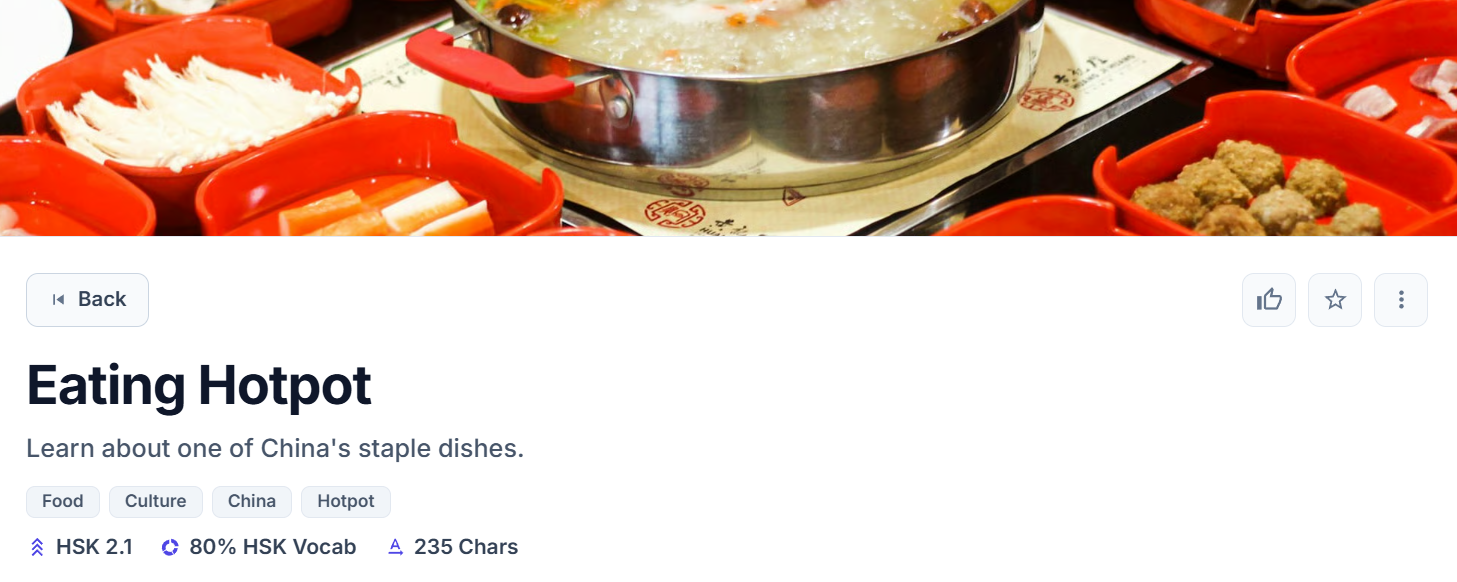
Back Navigation Button
Returns to the previous browse list or category page.
HSK Difficulty Score Badge
Calculates the weighted average difficulty level of the passage based on the HSK 1–6 framework.
% HSK Vocabulary Coverage
Displays the percentage of vocabulary in the text that belongs to official HSK curriculum word lists.
Unit Metric Counter
Shows total content length using context-specific units: Chars for articles, Messages for dialogues, or Sentences for lists.
Module Actions (Like / Favourite)
Like the passage or bookmark it as a Favourite for quick access.
Understanding HSK Badges: Official, Estimated (ᴱ) & Non-HSK
HanyuHub categorizes vocabulary using the established HSK 1 through HSK 6 framework. When viewing word cards, search results, or dictionary definitions, you will see three types of HSK badges:
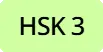
1. Official HSK
Word appears verbatim on the official standardized HSK curriculum.
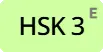
2. Estimated HSK (ᴱ)
Compound term analyzed by constituent characters to calculate an estimated HSK tier.

3. Non-HSK
Contains characters outside the HSK framework, so an estimated tier cannot be calculated.
- What it means: The word appears verbatim on the official standardized HSK vocabulary syllabus.
- Example:
开始(kāishǐ) is an official HSK 2 term.
- What it means: The term is an authentic, real-world Chinese word or compound phrase that is not explicitly listed as a single entry in the standard HSK syllabus.
- How it's calculated: HanyuHub's linguistic engine breaks down the constituent characters inside the word, analyzes their individual HSK levels, and calculates a weighted difficulty score.
- Why this helps you: Instead of labeling non-syllabus words as "Unknown", you get an accurate gauge of the reading level required to understand the term!
- What it means: The word is not listed on the official HSK syllabus and contains individual Chinese characters that fall completely outside the HSK 1–6 framework.
- Why it's labeled NON-HSK: Because the constituent characters are not part of the HSK curriculum, an estimated HSK difficulty tier cannot be calculated.
Difficulty Scores & Passage Metrics
- Measures the overall average difficulty of an entire article or dialogue.
- Example: A score of
HSK 1.4indicates a beginner passage containing mostly HSK 1 vocabulary with a few introductory HSK 2 terms sprinkled in.
- Displays the exact proportion of words in the passage that belong to official HSK curriculum decks vs. supplementary real-world words.
- Higher percentages mean the passage is ideal for targeted HSK exam preparation.
Each content format displays a length counter tailored to its structure:
- Articles & Stories: Total character count (e.g.,
235 Chars). - Dialogues & Conversations: Speech bubble message count (e.g.,
4 Messages). - Sentence Lists: Total sentence count (e.g.,
3 Sentences). - Lessons: Estimated completion duration (e.g.,
⏱ 35 Mins).