
Language Points
Master Mandarin sentence patterns, grammar formulas, correct vs. incorrect examples, and HSK levels.
Overview
Language Points break down Mandarin grammar into clear, visual building blocks. Instead of overwhelming you with abstract linguistic theory, each grammar point provides visual formula patterns, concrete usage rules, and real-world examples showing both correct usage and common learner mistakes.
Browsing & Level Groupings: HSK vs. CEFR
When exploring the Language Points library, grammar rules are organized by international proficiency standards. You can sort and filter by difficulty, but by default, the library is grouped by CEFR tier (e.g., CEFR A1, A2, B1):
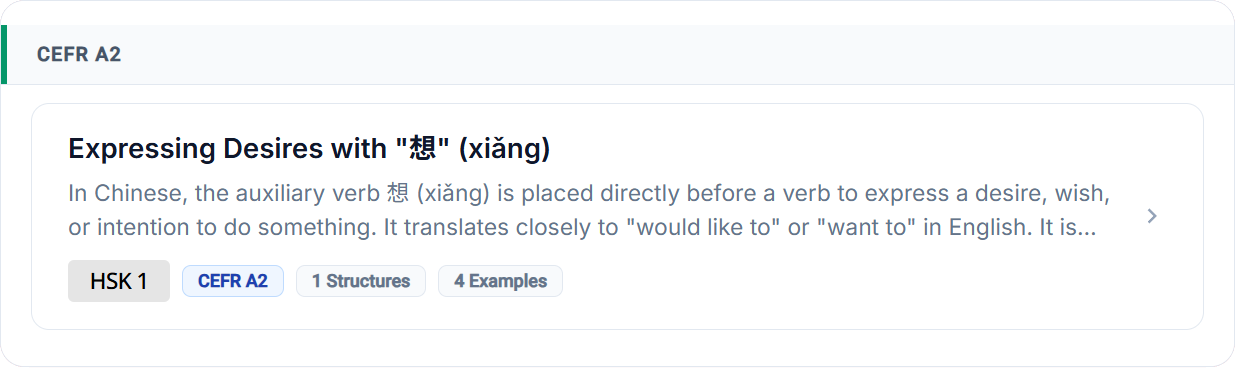
Understanding the Difficulty Badges
- Levels:
A1(Beginner) throughC2(Mastery). - What it measures: Practical, functional communication ability used by language educators worldwide. Grouping by CEFR ensures grammar points are ordered by real-world speaking and comprehension utility.
- Levels:
HSK 1(Introductory) throughHSK 6(Advanced). - What it measures: The official standardized Chinese proficiency exam framework, tracking the exact vocabulary and grammar syllabus tested on official exam tiers.
Anatomy of a Language Point
A single grammar concept often contains multiple variations or sentence patterns. Each Language Point is broken down into three focused components:
1. Title & Concept Overview
Provides a concise summary of when and why the grammar point is used (for example, using 想 as an auxiliary verb to express polite desires like "would like to").

2. Sentence Structure Formulas
Each pattern displays a clear, boxed equation breaking down sentence constituent order, followed by notes on placement nuances, exceptions, and negation (such as placing 不 directly before 想 to form 不想):

3. Example Sentences & Common Mistakes
Directly beneath each formula, you'll find curated example sentences with synchronized Pinyin and English translations:
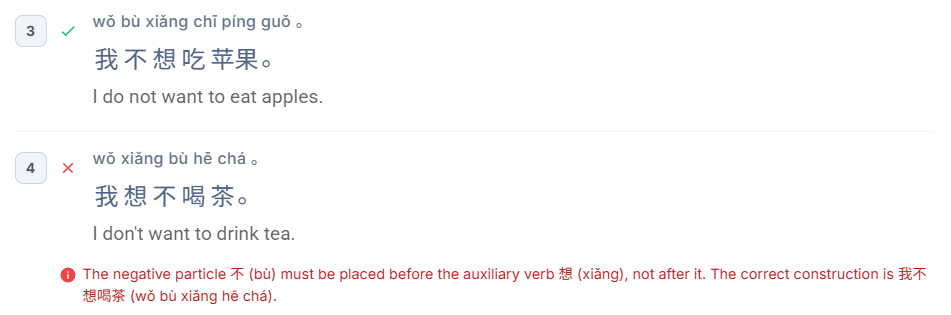
- Correct Usage (): Demonstrates natural, standard sentences as spoken by native speakers.
- Common Mistakes (): Highlights frequent traps and grammatical errors that non-native learners make.
- Error Explanations: Every incorrect example includes a detailed notice explaining why the construction is ungrammatical and how to fix it.
Reporting & Feedback
If you ever spot a typo or want clarification on a grammar nuance while studying, click the Report button in the top-right corner of any Language Point to submit quick feedback directly to our team.